Getting to ‘yes’ in negotiation
Achieving win-win in negotiation
Negotiation is a process of communication between two or more parties with the purpose of reaching an agreement that is acceptable to all. The different sides need to resolve their differences in order to reach a resolution. Thus, there is a need for interaction and effective communication between the parties. Agreeing on the terms of a job offer, an external contract or a yearly budget all require negotiation in the workplace.
Forms of negotiation
Negotiation takes many forms. The most appropriate approach to adopt depends on the context and what is considered important. If the interaction is one-off and there is no ongoing relationship, then a competitive approach may be chosen where negotiators try to optimise the outcomes. This results in a win-lose situation where one party’s gain is a loss for the other party. On the other hand, if the parties need to work together over an extended period of time, maintaining a positive relationship of trust and goodwill becomes important.
In this blog, I will focus on the latter situation and, in particular, on a style of negotiation known as a collaborative or an interest-based approach. In this, the parties problem-solve together and aim to reach a creative solution that satisfies all. The result is seen as a win-win.
Negotiation and the Iceberg model
In negotiation, the involved parties start out in disagreement and will state what they want to achieve from the process. This is their opening position.
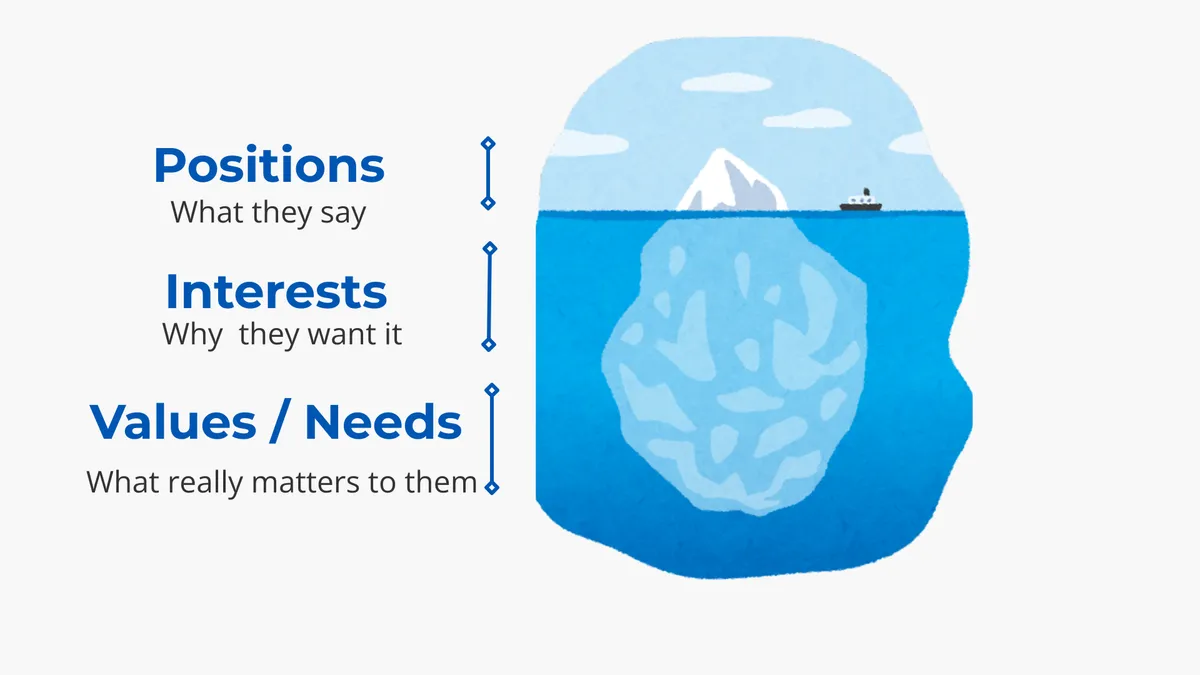
The iceberg model is both a useful metaphor and model in negotiation practice, especially when seeking to maintain a good working relationship. The idea is that, like an iceberg, what is on the surface is only a small part of the story. Hence the common expression “This is only the tip of the iceberg”. There is a great deal underneath and it takes exploration to discover what is there.
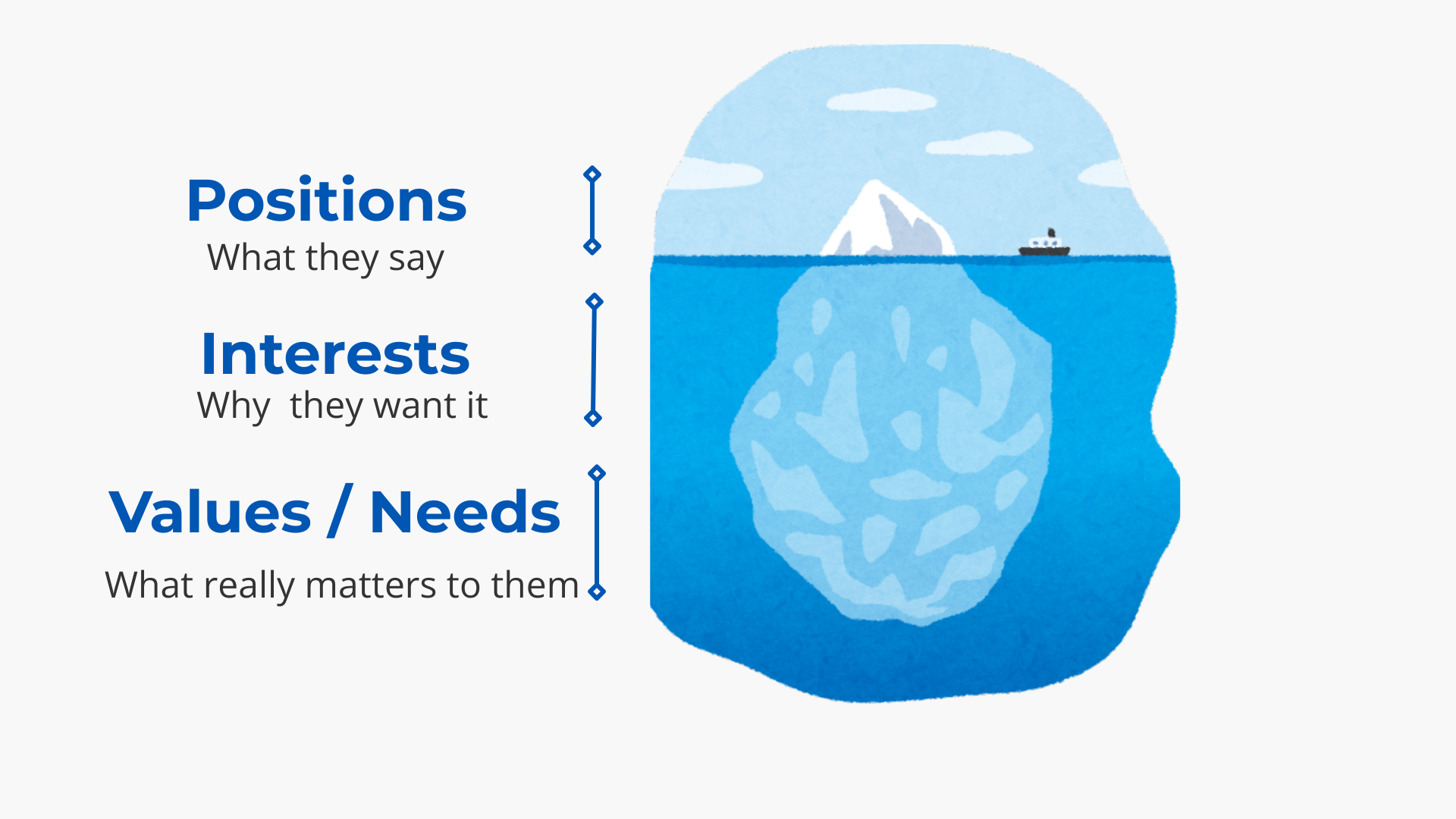
The iceberg model identifies three levels of communication:
The tip or surface which is visible consists of demands, formal arguments and emotional reactions. This is the realm of positions, often the starting point of a negotiation. “These are my terms for accepting this contract. This is what I want.”
The middle layer is where interests lie. These are the reasons underpinning the position - the objectives, motives or desired solution to a problem. “I want these terms because they ensure that I get a fair deal for my investment."
At the deepest layer lie core values, needs and fundamental principles. These are what really matter. “I want these contract terms because they provide security for my business”.
When someone says 'no'
Imagine that you are negotiating the yearly budget for your department or a promising new contact with a potential investor. The other person responds to a proposal that you have just made with a definitive-sounding 'no'.The first instinct in such cases may be to defend the proposal, argue its merits or even offer a concession. However, in terms of the iceberg model, this is working at the surface level, that of positions. A focus on positions leads to defensiveness and rigidity. Each person only sees how what they want differs from the other. The options appear limited or even mutually exclusive. “My department must have a 10% increase in budget this year” versus “The company has to cut costs this year”.
By taking the conversation deeper and asking curious questions, a negotiator opens the space to explore the interests and needs of each party.
“What problem will a 10% increase in budget solve for you?”
“Why does the company need to cut costs this year?”
This moves the conversation away from questioning positions to finding common ground. Going to a deeper level opens the space for sharing of values and needs. For example, one party has stated that they are concerned about understaffing and missing important project deadlines. Asking “What impact would missing a deadline have on you?” may lead to expression of a need to fulfil commitments or a fear of failure if clients are lost.
Dealing with tension in negotiations
During negotiations, differences come to the surface and may result in a change of dynamic between people in the room. It can be perceived as a tension, friction, an uncomfortable silence or a change in the tone of language. If the issue that caused the change is ignored, those present may become more irritated and uneasy. Feelings of fear, anger or apprehension may appear. The discussion can go around in circles and lead nowhere.
In such situations, the iceberg model is again a useful tool. When feeling attacked, people stop listening to each other, go back to their position and try to defend it.
Useful strategies include:
Acknowledge what is happening. Many people will deny that there is a conflict. This does not make the disagreement disappear.
Notice your own reactions to the tension. How do you react? How do you feel?
Take a deep breath and step back. The expression ‘I saw red’ refers to a person becoming very angry and acting without thinking. If you are experiencing strong feelings, allow your emotions to calm down before saying or doing anything.
Listen to the other person(s). Ask questions and encourage them to go down the iceberg and talk about their interests and what they need.
Final words
Negotiation is not a straightforward, linear process. Thinking in terms of moving up and down the iceberg from positions to interests to needs and back can help in working with the frustrations that may arise. If the argument is going around in circles and making no progress, the parties have likely moved back to their positions. Open curious questions can open up space for moving to what really matters to them and to finding sustainable, win-win outcomes.
Based on content originally published in the Communicate with Confidence LinkedIn newsletter
If this aspect of professional English resonates with you, sign up here for Professional Communication Insights and receive an email every 2 weeks with practical ideas and strategies for effective communication. It is free and you can unsubscribe any time.


